


My Year With Hitchcock: March

This year (2026), from January until December, I'll be watching every Alfred Hitchcock film I can find. This is similar to the viewing projects I did for Woody Allen in 2016 and Disney Animation in 2022. I'll be watching a different movie each week, in chronological order and reviewing them as I go. The rule for the reviews is that I cannot reference any movie I have not yet watched. They don't exist yet. Each film is reviewed as if it were brand new (sort of). The only difference this time is that I have to watch two movies a week in January and February, since there are more than 52 movies to watch (plus TV stuff later on). Reviews will also be posted on my Letterbox'd page.
This is everything viewed in the month of March.
WEEK 9
Murder! (1930) - 102 min.
Watched on 3/1/26
Availability: Kino DVD

The film opens with Beethoven's 5th setting the tone for what promises to be another fun suspense film from Hitchcock, who had, at this point, proven that stories of dark deeds and Murder(!) were his preference. After “The Lodger” and “Blackmail,” it was clear where his talents lie and what got him thrilled to make movies in the most imaginative way possible.
Unfortunately, “Murder!” only displays those talents in fits and starts and it often gets bogged down in the limitations of the technology of the time. It’s based on a play where a woman gets accused of a murder and is put on trial. In the jury deliberation room, a professional actor, Sir John (Herbert Marshall), and his fellow jurors argue over the merits of the case and eventually find her guilty. Unable to live with it on his conscience forever, Sir John investigates further enlisting the help of a couple of his fellow jurors.
I had a hard time warming up to this one at first. It didn’t help that no subtitles were available, but I could also feel the material of the piece was too static for what Hitchcock wanted to do with it cinematically, though it is still many steps up from his previous effort, “Juno and the Paycock.” At least here, Hitchcock gets to play around with voiceover when Sir John replays the trial in his mind and goes over the moral implications of it all (Fun fact: Hitchcock actually had an orchestra performing the score off-screen and a pre-recorded inner monologue playing as playback, so that Marshall could react to it. Every single thing we hear was there on the set that day. Incredible).
The final act is also where the film finally comes alive as the mystery starts to unravel and Hitchcock gets to have the film’s climax as a circus. He makes the most out of a trapeze sequence that takes the film to its dark conclusion. Throughout the film, Sir John talks to the artists around him about the illusion of art, the function of artists and how “we use art to criticize life.” “Murder!” is all about the illusions we see and don’t see throughout our days and how those mis-perceptions can cost us a piece of our humanity. Even the final shot is another reveal that Hitchcock has used before to make the point about illusions in art and in life.
“Murder!” may not rank with the other two “best” Hitchcock films leading up to it, but it’s still a step in the right direction towards being the director Hitchcock wanted to be.
WEEK 10
Mary (1930) - 82 min.
Watched on 3/8/26
Availability: Kino DVD

Watching “Mary” a few days after watching “Murder!” is a bit of a waste of 82 minutes, if you're just wondering whether or not the DVD extra is worth the effort. Hitchcock begrudgingly did the studio’s bidding by filming a German version of the original film. He didn’t speak German and he didn’t care if the film turned out as good as the original. It all shows.
It’s shorter by twenty minutes and it certainly feels rushed. Even the plot to trap the real killer in the third act feels half-baked (no mention of “Hamlet” in the scheme this time. Just basically, “I have an idea, let’s cast a fake play and have him audition.” “Okay.”). Even the finale--where Hitchcock’s style truly shines in “Murder!”--gets a lackluster treatment. Sure, we get the cool shots of the tormented trapeze artist, but there’s no weight to it.
Even if one tries to naively give “Mary” the benefit of the doubt as a movie unto itself with no production backstory, the final product lacks tension and purpose. The trapeze sequence at the end might have still been memorable, but we’d be wondering if it could have been directed better and that’s not something I want to feel at the end of a Hitchcock film. Such an exercise is foolish, though. We know there’s a better film out there and it’s not even a great one.
WEEK 11 (one feature, one short)
The Skin Game (1931) - 82 min.
Watched on 3/16/26
Availability: Kino DVD

“The Skin Game,” at first, feels like another outing for Hitchcock during this period that was made as a contractual obligation and feels as dull and stilted as “Juno and the Paycock.” The story of two families trying to take control of an idyllic town called Deepwater, where residents have lived for over thirty years, starts out a bit awkward and disjointed, with Hitchcock using some visually striking transitionals to keep us interested, but they barely stay on screen long enough for us to truly admire them. It doesn’t help that the dialogue is often hard to hear.
Then, we start to catch up a bit, learn who everyone is a little further and what’s at stake. The Jackmans, one of those residents who have lived in Deepwater a long time, are about to be evicted by the Hornblowers, namely Mr. Hornblower (Edmund Gwenn), who would rather use the land for more financial gains. This is troubling news for Mr. Hillcrest (C.V. France), the current owner, who finds it unconscionable to kick these people out. Then comes the auction for the land. Here, Hitchcock draws us in further with a scene of comedy and suspense as the Hillcrests and Hornblowers try to outbid one another while the auctioneer uses every trick he knows to get the price higher and higher.
There is also a scandal that we learn about later that, again, begins to drag the movie down a bit, but again, gains momentum as the film wears on. These scenes give the actors more to chew on as they become more desperate, more conniving and duplicitous. With each act of sabotage, we wonder how it will all turn out. The final shot is like a dark coda signifying that this story never truly ends, that bad deeds beget more bad deeds, until people who are just trying to live in peace become victims as well.
I’m guessing this movie works better on a second viewing, but I liked that it at least surprised me just as I felt it was letting me down. Hitchcock tries to infuse some dark humor where he can, but the material only calls for so much. At least he has a dog to film for a while, as one of the characters keeps throwing a rubber ball into its mouth while a man stands off-screen trying to talk to her about important issues that should concern her. Why worry when there’s a cute dog to play with?
“The Skin Game” will never be remembered as one of his best. The melodrama in the third act isn’t quite as memorable as the scenes between Gwenn and France, or even better, Gwenn and Helen Hays as the icy Mrs. Hillcrest. It’s well-worn territory at this point in his career of adapting plays or novels about people who have a past they’re trying to hide from others, for fear of humiliation and scandal. Still, it’s several steps up from “Paycock” and maybe on par with “Murder!”, but again, I’m thinking a second viewing is in order… someday. Maybe.
Let’s Go Bathing (1931) - 5 min.
Watched on 3/16/26
Availability: YouTube capture, transferred to blu-ray
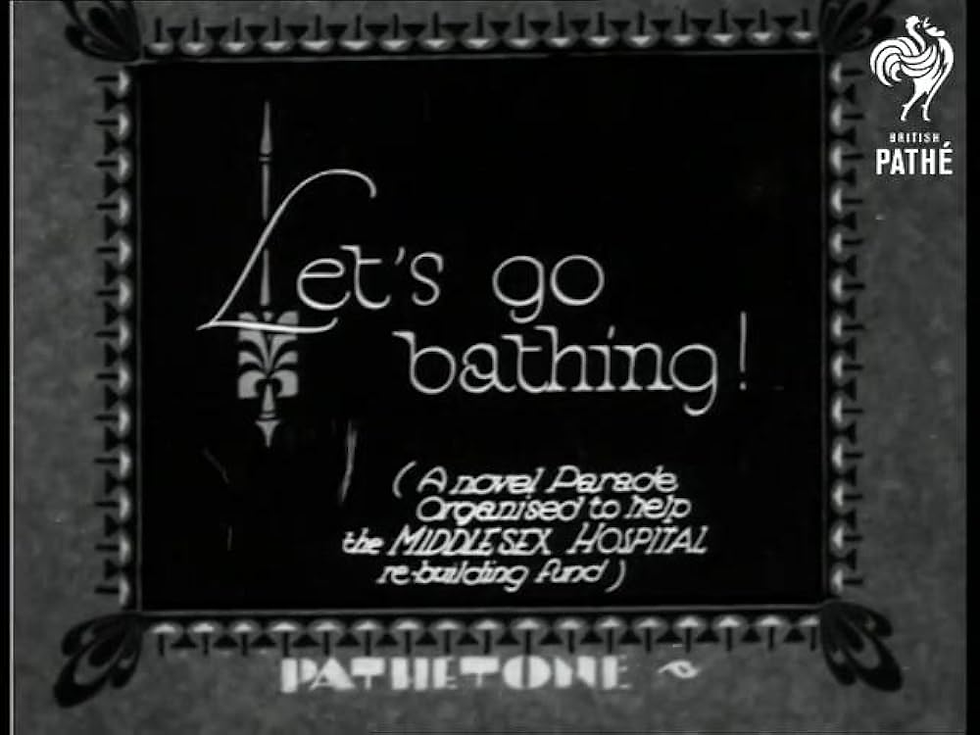
“A novel Parade to help the MIDDLESEX HOSPITAL re-building fund” the title card tells us. So it is. “Let’s Go Bathing” is a 4-minute assignment Hitchcock put together to help raise money for the Middlesex Hospital. In it, a man at the beach buried in sand, watches from afar as women parade out of a tent wearing the latest and greatest in beachwear. He then takes a swim with them. Then, an inarticulate woman addresses us telling us the purpose of the film.
That’s it. It’s a one-off that doesn’t have much merit and that no one would look twice at if it weren’t for the name attached to it. Moving on.
WEEK 12
Rich and Strange (1931) - 83 min.
Watched on 3/22/26
Availability: 2 Tales of Suspense DVD (paired with “June and the Paycock”)

It could’ve just been called “Strange.” The “rich” part simply describes the wealth that surrounds everyone, but the “strange” part is what the film feels like once it’s all over and the viewer is left wondering, “what was that all about?” Basically, Hitchcock made a movie where he could enjoy travelling to all sorts of locations around the globe instead of sitting around Elstree filming more tired novel/play adaptations on soundstages.
The film follows what feels like a kind of typical formula for a Hitchcock film during this period. A married couple, Fred (Henry Kendell) and Emily (Joan Barry), live a boring life. He comes home from another tired day at work and expresses his dissatisfaction with everything around him. As luck would have it, his Aunt leaves him a ton of money to go off and travel the world. The two are instantly on a cruise ship that takes them to exotic locations, while they each meet a stranger on the ship who already has wealth. Emily meets The Commander (Percy Marmont) while Fred lies sick in bed. Fred eventually meets The Princess (Betty Amann) and is instantly infatuated with her. The more time Fred and Emily spend apart and with these other two, the more they drift apart.
Here’s where things get strange. First, the craft. Hitchcock seems to really want to go back to making silent films, which is not a hindrance here. So many visual gags and choices work, from the dizzying and thrilling opening sequence to his uses of a subjective lens. On the other hand, the silent film technique is given extra attention via oddly placed title cards that keep reiterating where we are, what character we’re focusing on and what we’re meant to think of them. We also get geographical instructions, such as “In order to get to Paris, you have to cross the Chanel.”
Then there’s the last 20 minutes when it seems our couple has had to accept that they’re not among the elite class like they think they are and have to start over as a couple (or not). The story takes a turn when the cruise ship crashes and almost completely sinks, with Fred and Emily trapped inside their room. What happens next would make an interesting movie in itself and one wishes someone would’ve had this idea for a whole film instead of the film we’ve been watching. Just this couple, stranded.
Then again, there’s little to like about either of them. We stop caring at some point. Maybe it’s how Fred constantly treats their cat (and why did they bother to bring the poor animal?), but also how he treats Emily. We don’t have any reason to believe he’s going to really treat her any differently after all this, but the movie’s forced ending wants us to believe they still have a shot together. By the end, we wonder why Hitchcock wanted to make this movie in the first place. It has been suggested that his interests were personal, based on the idea that he and his wife now had privilege and could now travel the world between projects. A documentary about that would certainly be worth watching and does add a layer of curiosity for this one.
WEEK 13
Number Seventeen (1932) - 63 min.
Watched on 3/31/26
Availability: Kino Lorber DVD

The title of Hitchcock’s “Number Seventeen” refers to an address of an abandoned house where the characters meet up. We first get a look at the house through a wordless introduction as a man cautiously enters, looks around and finds a cockney Englishman named Ben (Leon M. Lion) who has little reason to trust this guy, and vice versa. Soon, more characters populate the house and we gather they just came back from a jewel heist. Three men, one woman and one of them might be a detective. There is also a dead body.
This reads like an intriguing set-up for what might be one of Hitchcock’s more enjoyable films from this era. Sadly, it only engages about half-way, and not consistently. The characters are hardly distinguishable from one another, save for Ben, who is the highlight of every scene, even if his accent is thicker than anyone else’s (a detriment from this era when sound recording of anything was still in its infancy. Also, take a drink every time he calls someone “guv’nuh”). The script went through many changes and Hitchcock had to deal with budgetary constraints, leaving the first half of the film to be a bit duller than it might have been if these setbacks hadn’t occurred.
Hitchcock clearly had more invested in the film’s second half aboard a train where the excitement really kicks into gear. Everyone is on board, but one character has to hijack a bus and drive it at full speed to keep with the train and try to somehow derail it. Finally, after all these dreary talkies, Hitchcock finally gets to have some fun with a fast-paced bit of action that involves models, undercranking, suspension of disbelief and car crashes. It moves at a breakneck pace and turns out quite good given the limitations and the fact that the Brits during this time weren’t exactly experts at this sort of thing.
And then it’s over. At 63 minutes, “Number Seventeen” doesn’t exactly waste any time, but it almost doesn’t seem worthwhile enough to make the effort. By the end, I still didn’t care one bit about any of the characters or who might be the detective. It’s a beautifully stylized chamber piece in the first half where the characters are almost in the way of a good shot, and a chase film in the second half that, again, is mostly notable for its technique than anything else. Hitchcock does make good use of a stair rail that gives way to one of the more suspenseful scenes in the first half, so there is that as well.
Watching it in the context of a year-long Hitchcock binge (in chronological order) probably gives it a bit of a boost. There is more here to enjoy than some of the other films of this era and it’s good to see Hitchcock having as much fun as he can with his toys while not really giving the actors much to do. It clips along, gives us some cool visuals and tries to dazzle us mostly in the back half. There’s no third act beyond that, really, but that’s not exactly a disappointment.


Comments