


My Year With Hitchcock: May

This year (2026), from January until December, I'll be watching every Alfred Hitchcock film I can find. This is similar to the viewing projects I did for Woody Allen in 2016 and Disney Animation in 2022. I'll be watching a different movie each week, in chronological order and reviewing them as I go. The rule for the reviews is that I cannot reference any movie I have not yet watched. They don't exist yet. Each film is reviewed as if it were brand new (sort of). The only difference this time is that I have to watch two movies a week in January and February, since there are more than 52 movies to watch (plus TV stuff later on). Reviews will also be posted on my Letterbox'd page.
WEEK 18
Sabotage (1936) - 77 min.
Watched on 5/4/26
Availability: HBO Max (or whatever it’s called now)

The sound of laughter permeates much of “Sabotage,” even though it’s not a comedy. The film opens with a power outage in London, the result of which makes for a common inconvenience among the citizens that they can’t help but laugh about it together. Later in the film, a movie theater audience is seen laughing at the antics on screen, whether from a screwball comedy or a Disney cartoon.
Yet, little do they know, there is danger all around them. “Sabotage” is the first, most literal example of Hitchcock’s “bomb” theory of suspense. We know more than the average citizens do, or even some of the main characters, and we plead with them to notice what we notice, or everyone will parish. Just as we look at world history during this period and see much of Europe going about its day, we know the Nazis are out there during this time and we wish for a time machine to warn everyone before it’s too late.
Hitchcock plays with the audience’s expectations right from the get-go as we are introduced to our two main characters, the Verlocs, who own and operate the local Bijou theater. Karl (Oscar Homolka) has been a secret agent for a while by the time we’re introduced to him, working as an unassuming everyman while carrying out massive disruptions so that other nefarious plans can work. His unsuspecting wife (Sylvia Sydney) runs the theater and becomes our eyes into the ordinary as extraordinary events unfold around them.
There is one amusing moment when their young son innocently talks about gangsters appearing to be ordinary people while being ruthless killers, all while the camera stays fixated on Karl as he conducts some epistolary espionage. It reminded me of the comically reoccurring use of the word “knife!” in “Blackmail”. There’s a part of us that waits for Karl to have a crisis of conscience about his actions and this might be the closest we get to that.
“Sabotage” flies by in its 77 minute run time. It has enough memorable sequences to make it better than an average director’s version of a by-the-numbers film. It has familiar Hitchockian beats, but they still work in the moment. Oh, and the cartoon “Who Killed Cock Robin?" is one of the darkest Disney cartoons ever conceived and fits in perfectly with Hitchcock’s sense of humor. Of course, he picked that one to be featured here. Why? Because there are birds singing in it and, of course, it’s funny.
WEEK 19
Young and innocent (1937) - 83 min.
Watched on 5/10/26
Availability: Alfred Hitchcock Classics - 8 Films on 2 DVDs

By now, it’s obvious what Hitchcock loves: He loves his trains, his dogs, his complex tracking shots, his funny bar brawls, his mistaken identities, his clueless hordes and his use of entertainment–a play, a movie, an orchestra or, in this case, a nightclub act–as the backdrop for the big climax. “Young and Innocent” sees Hitchcock playing with his favorite toys once again and, by now (watching his films in chronological order over the course of a year), we know what we love about this era, too. We’re also ready for a change-up.
“Young and Innocent” is a breeze to sit through and if I didn’t have so much going on the week I watched it, I might have more to say about it. Or, maybe not. It follows a young writer (Derrick de Marney) who is wrongfully accused of murder of a stage actress. The film is essentially a long chase as he evades cops and other people who could do him great harm. The only one who might save him happens to be Erica (Nova Pilbeam), who happens to be the constable's daughter. Naturally, they go through this adventure together and fall in love (another one of Hitchcock’s favorite tropes).
We also get the memorable sequence where Hitchcock builds suspense at a children’s birthday party as our heroes become unwitting participants. As the tension builds, the appearances become sillier; serious stuff going on while everyone wears funny hats. Also charming is de Marney’s attorney with the sunny disposition and who tells him (in so many words), “you’re probably guilty, but do not despair. The sun is out and it’s a beautiful day.” Then, of course, there is the stand-out crane shot that travels through the nightclub and right up to the eyes of one of the orchestra players, a shot that Hitchcock scholars love to write about, in spite of the garish looking blackface that concludes it.
“Young And Innocent” isn’t truly awful, but the cracks in the storyline are hard to ignore, particularly in the set-up when de Marney is first being accused of murder by two onlookers who saw him running away from the corpse. No one ever considers that he might be running to get help. This is a flimsy premise to set the story in motion, but everything hinges on that moment. Hitchcock and his writers have already established that you need more to presume guilt for an innocent man, but they seemed content to let that plot hole slip by. Perhaps they all assumed the craft and performances will be enough to sell it. Not quite.
These are the main take-aways from this film, a film that when I look back on my year of watching every Hitchcock film, many for the first time, I might come across this title and think, “which one was that again?” And then, I will likely look up my review of it here and go, “oh, yeah. Okay. I kinda remember it.” And then move on. I enjoyed it enough, but I’m also running out of ways to write about this era.
WEEK 20
The Lady Vanishes (1938) - 96 min.
Watched on 5/17/26
Availability: Criterion DVD checked out from library

During the first half-hour or so of "The Lady Vanishes,” I thought to myself, “Do we have to have a plot? ‘Cause I could watch this ‘Fawlty Towers’ prototype all day.” From the perfectly executed first gag of peace-and-quiet in this mountainside hotel that turns to instant chaos one second later, “The Lady Vanishes” sees Hitchcock taking great pleasure in seeing his characters once again being stuck in a situation beyond their control, not unlike the power outage in “Sabotage” that bonded the locals together with laughter. This time, though, we’re the ones laughing.
Eventually, the film swerves away from satirizing English behavior and settles into an intriguing plot involving a young woman on a train, Iris (Margaret Lockwood), who cannot figure out the whereabouts of an older woman (May Whitty) she talked to earlier on the train and why no one around her will even acknowledge the woman existed in the first place. Hallucination? Fever dream? Subconscious manifestation? What will the answer be? In the meantime, she meets the charming Gilbert (Michael Redgrave), who does what he can to help Iris figure out this mystery.
Every one of the characters aboard the train is a movie in themselves, from the gay-coded (but barely) Englishmen (Basil Radford and Naunton Wayne) who cannot fathom how any proper English person does not follow cricket like a religion to the woman on the train herself, not to mention the pseudo-magician who tries to thwart Iris and Gilbert in a car loaded with magic tricks and animals that are all put to brilliant comic effect.
Somehow, amidst all the goofiness taking place, Hitchcock still manages to effortlessly move between high comedy and tight thriller. Iris’ plight becomes worthy of our investment, not just because we like her, but because we want to see how everyone we’ve gotten to know responds to her pleas for sanity. Because of their stuffy behavior, they all become obstacles. The script, even when it has to slow down and become a plot-driven story, never loses sight of the satire it started out with in the first half-hour. Hitchcock still wants to skewer English behavior and give it a kick up the backside, but that would be too easy in and of itself.
“The Lady Vanishes” has many Hitchcockian visual tricks (the opening shot is an ambitious crane shot, even if it’s plainly obvious to today’s eyes that the entire structure is a miniature), but they don’t become the main take-away as they have in some cases leading up to this point. He seems far more invested in the mechanics of the story and the humor surrounding it than pulling off an illusion.
“The Lady Vanishes” still has the same attention to details and tight pacing that characterized much of his work during this period, but it's a far less sloppy story than “Young and Innocent” and the characters are worth the investment. Easily one of the best of this decade.
WEEK 21
Jamaica Inn (1939) - 100 min.
Watched on 5/24/26
Availability: Kino disc checked out from library

People kept telling me that “Jamaica Inn” would be among the worst Hitchcock films I would see for this project (a year of watching every single Hitchcock film, in chronological order, many for the first time). While it certainly belongs in the very bottom half of a ranked list, there are at least elements of it that I found amusing and even amazing, particularly the opening sequence of the shipwreck that sets the story in motion and introduces us to our villains. Also, at least there is one central villain to the whole thing (scenery-chewing Charles Laughton) that even some of his best films don’t have at all. And there is the arrival of a gorgeous Maureen O’Hara at the beginning of a rich career.
So, it has a few things going for it. That all being said, “Jamaica Inn” feels flat in comparison with the strong run of films that preceded it, starting with “The Man Who Knew Too Much.” This feels like something made just before that, a Hitchcock film that we forgive for its strengths more than we look down on because it doesn’t measure up to “The 39 Steps” or “The Lady Vanishes.” It feels like it belongs in the same era of films that gave us “Waltzes From Vienna,” “Rich and “Strange” and “Number Seventeen.” These aren’t great Hitchcock movies, not by a mile, but they each have something interesting in them. By now, interesting isn’t enough, so “Jamaica Inn” feels like a step backwards after several steps forward.
What’s missing is the dark humor, though Laughton tries to fill that gap. It’s well documented that Hitchcock hated working with him, but that doesn’t make Laughton’s performance less of a show, one I didn’t mind watching, since his character is supposed to be a pretentious, unstable prat. What’s also missing is Hitchcock’s trademark visual storytelling. It’s like we’ve travelled back in time to his early talkies where he felt confined by the lackluster material and showed little interest in elevating it cinematically.
Then, there is the disappointing answer to the set-up where the titular location is given a horror movie-like treatment as O’Hara tells everyone that she needs to get to Jamaica Inn and gets looks of fear from every local she encounters. We want to see the reason behind their fears, but it turns out to be a bunch of arguing, incompetent pirates who steal from shipwrecks. Once she gets tangled up with them, as well as another shipwrecked individual named Jem (Robert Newton), the two hide in plain sight quite a few times as they listen in on secret discussions and learn what we already know.
So, there is also the lack of suspense, which is saddest of all. Again, this kind of film would be expected in the late ‘20s/early ‘30s, but not at this point. While it might be a change of pace from the spy thriller formula that started to become a bit too familiar during his time in the mid-to-late-thirties, this change of pace comes off more like a time-out than as a continuation of the momentum he appeared to be enjoying. It’s not his worst film (at this point in the year, in May, I have nine films I would rank below it), but that shouldn't even be a conversation for a 1939 Hitchcock film.
WEEK 22
Rebecca (1940) - 130 min.
Watched on 5/31/2026
Availability: Criterion blu-ray
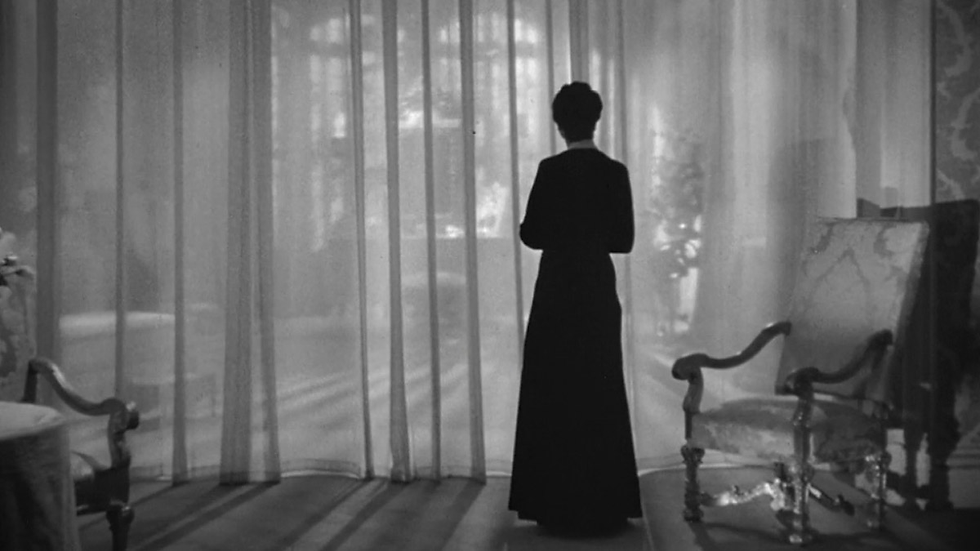
Finally, instead of opening with a British Film Institute certificate of acceptance (or however it’s phrased), Hitchcock’s first American production kicks off with Selznick International Picture fanfare as he begins this new chapter in his career. Oddly enough, though, “Rebecca” still feels very British. The style of the performances and some of the very British mannerisms still exist here, but there’s one notable difference: The budget. Hitchcock now gets some of that Hollywood money and certainly makes the most of it.
The Manderlay mansion, where much of the film takes place, is a sumptuous series of sets, all with tall ceilings, lavishly detailed designs adorning every dining room and bedroom, unusually high doorknobs, neverending hallways and striking shadows that accompany every movement. No expense has been spared in bringing this gothic wonder to life as we feel both comfort and dread while the newly wed Ms. DeWinter (Joan Fontaine) makes her way into this new world of highly judgmental upperclassmanship and never quite finding her footing. With every shot during her first night in the place, she is increasingly dwarfed by her opulent surroundings.
What stays with me the most about “Rebecca” is the screenplay’s reluctance to ever see the titular character. We hear her name mentioned many times throughout, but we have to put all the pieces together. Our heroine has to do the same thing. The experience of watching “Rebecca” is not unlike the characters in “Citizen Kane” trying to put the pieces together of someone’s life. Much like that film, as soon as we have the last few shapes of the puzzle, we have to watch it all go up in smoke. “Rebecca” is a ghost story, but only bordering on horror, and Hitchcock wants to haunt the characters as well as his audience. It’s what you don’t see that makes that happen.
This is Hitchcock’s most unsettling film up to this point in his career, but there is still a playful side to it that makes it feel like he never left his roots and wasn’t in danger of doing so anytime soon. One of the clues to Maxim de Winter’s (Laurence Olivier) darker tendencies comes when he and Ms. De Winter are in a romantic embrace and he wistfully says “...and I shall make violent love to you.” We don’t doubt it. Also, when you look closely at the address book or Rebecca’s former acquaintances, there is a gentlemen going by the odd name of Sir Nigel Armbuster. There’s also the score when the maid mentions “this was Mrs. DeWinter’s room” that sounds like a silent film music cue and is darkly ominous. Little details such as these are fun to pick up on with repeat viewings.
Of course, the performances carry the film better than anything else. There’s not a false note among them. Fontaine exudes the naive charm of a woman swept off her feet, but grounds her character with intelligence and grace that keep us on her side and never questioning her belief system. Olivier keeps us fearful and uneasy as we try to put the clues of his wife’s disappearance together while also hoping Ms. De Winter makes it out of a scene unscathed. Finally, there is Judith Anderson as Mrs. Danvers, the maid cloaked in black as if she’s in a forever state of mourning. Icy and pointed, she casts a dark spell over every single scene, right up to the very end.
“Rebecca” can easily be called a masterpiece that marks a major chapter in Hitchcock’s filmography. It’s his first American production, of course, as well as his longest film to date at this point, but it’s also the kind of film he might have made better several years prior if he had the proper talent working with him and the right budget. It’s not a spy thriller or a stuffy drama, but it’s just as thrilling and the drama is never undercut by a gag of some kind to keep Hitchcock interested. “Rebecca” has elements of a thriller, but Hitchcock isn’t out to be a showman this time around. We remember it for its characters and complexities as well as the experience of drinking in all its gorgeous cinematography. Even without his tricks, Hitchcock can still make a movie that is the whole package.


Comments